





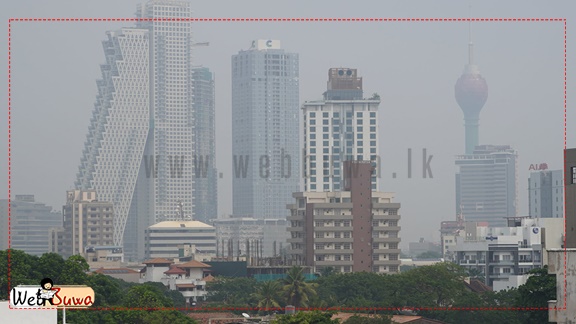
A surge of polluted air drifting from India has significantly worsened air quality in several parts of Sri Lanka, prompting renewed warnings from environmental and health experts.
The National Building Research Organisation’s (NBRO) Air Pollution Management Unit confirmed that air quality across the island has deteriorated sharply due to transboundary air pollution.
Chief Scientist Sarath Premasiri stated that polluted air masses entering Sri Lanka from the Indian subcontinent have led to elevated concentrations of PM2.5, particularly in the northern, central, and western regions.
According to the Air Quality Index (AQI), several districts have recorded unhealthy or near-unhealthy levels. Jaffna reported an AQI of 138, classified as unhealthy, while Kegalle recorded 86, indicating moderate to unhealthy levels for sensitive groups. Vavuniya and Galle recorded AQI readings of 79 and 76, respectively.
The Dynamic Air Quality Map highlights these conditions with deep red and orange zones, reflecting widespread deterioration in air quality. In addition, concerning PM2.5 levels have been observed in several cities, including Badulla, Colombo, Kolonnawa, Kotte, Monaragala, Puttalam, Trincomalee, and Anuradhapura. Many of these areas fall within yellow, orange, or red categories, indicating potentially harmful conditions for the general public and heightened risks for vulnerable groups such as children, the elderly, and individuals with respiratory illnesses.
Authorities emphasized the need for continued vigilance until air quality conditions improve.