





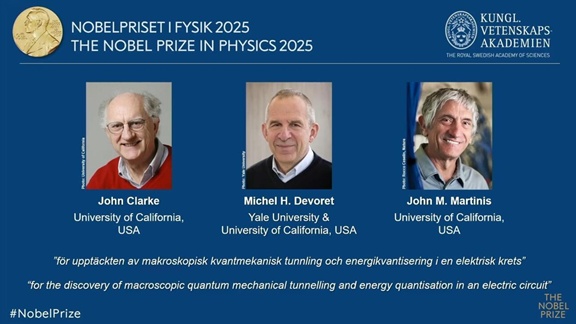
The Royal Swedish Academy of Sciences has awarded the 2025 Nobel Prize in Physics to a trio of United-States-based scientists for work on quantum mechanic tunnelling.
The award, announced by the Royal Swedish Academy of Sciences on Tuesday, will be presented to John Clarke, Michel H Devoret, and John M Martinis in December “for the discovery of macroscopic quantum mechanical tunnelling and energy quantisation in an electric circuit”.
The trio’s experiments demonstrated that quantum mechanical properties can be made concrete on a macroscopic scale, the prize-awarding body said in a statement.
Their work has “provided opportunities for developing the next generation of quantum technology, including quantum cryptography, quantum computers, and quantum sensors”, it continued.
Clarke, a British-born professor at the University of California, said the team’s discovery “in some ways is the basis of quantum computing”.
“Exactly at this moment where this fits in is not entirely clear to me,” he added.
Quantum computing is a new kind of computing that uses the principles of quantum mechanics – the science of how particles behave at the smallest scales – to perform calculations much faster than conventional computers.
Quantum mechanics is the “foundation of all digital technology”, noted the chair of the Nobel Committee for Physics.
‘The surprise of my life’
“I’m completely stunned. Of course it had never occurred to me in any way that this might be the basis of a Nobel Prize,” Clarke told the Nobel news conference by telephone. “To put it mildly, it was the surprise of my life.”
He paid tribute to his fellow laureates, saying, “Their contributions are just overwhelming.”
Devoret, born in France, is a professor at Yale University and the University of California, where Martinis is also a professor.
The prize of 11 million Swedish kronor ($1.17m) is to be shared equally between the three.
Speaking from his cellphone, Clarke added: “One of the underlying reasons that cellphones work is because of all this work.”
Olle Eriksson, chair of the Nobel Committee for Physics, said it was “wonderful to be able to celebrate the way that century-old quantum mechanics continually offers new surprises”.
“It is also enormously useful, as quantum mechanics is the foundation of all digital technology,” he said.
(Al Jazeera)