







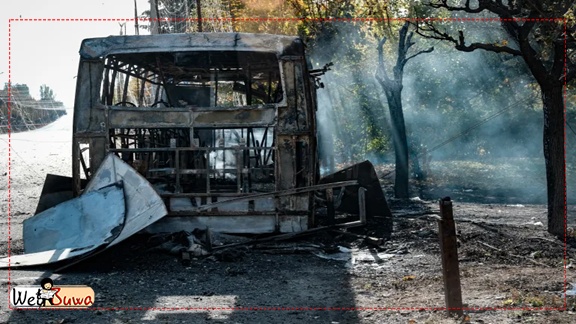
A Russian glide bomb struck two passenger buses in the eastern Ukrainian town of Kramatorsk on Thursday morning, killing at least 30 people and wounding 18, regional authorities said.
Ukrainian officials said the attack was deliberate. When dropped from planes on the Russian side of the front line, such bombs can glide to fixed coordinates on the ground, in this case, a street in the town that lies about 20 kilometres (12.4 miles) from the front line.
“The Russians are deliberately targeting civilians,” regional administration head Vadym Filashkin wrote on Telegram. “For them, a bus full of passengers is an attractive target precisely because a single strike can kill the maximum number of people.”
“Russia consciously disregards all conceivable rules of warfare and norms of international humanitarian law. It selects targets where it can inflict the greatest suffering on civilians,” he wrote.
Filashkin ordered the suspension of the movement of all public transportation in Kramatorsk and neighbouring Sloviansk as Russia intensifies attacks, paralysing Ukraine’s transport infrastructure, from trains and minibuses to gas stations, bridges, seaports and freight ships.
“This is a new Russian tactic,” Volodymyr Fesenko, head of the Kyiv-based Penta think tank, told Al Jazeera. “They used to focus on depriving Ukraine of power, on switching off electricity and heating; now their task is also to immobilise the infrastructure, create a transportation collapse.”
“Unfortunately, Russia’s tactic has a certain effect with their strikes on railroads, gas stations,” he said. “They coerce to peace on their conditions.
“They also strike the public psychologically, disrupt the usual lifestyle in general.”
Throughout the war, Russia has denied it targets Ukrainian civilians, a statement that means little to Ukrainians. During the first eight months of 2026, 15,280 civilians were killed or injured, according to the United Nations – a toll that is 55 percent higher than during the same period in 2025.
With no civilian planes in the sky since Russia’s 2022 full-scale invasion, trains, buses and trucks have become a lifeline for Ukrainian civilians and businesses, as well as for transporting military and humanitarian supplies.
Trains handle almost two-thirds of Ukraine’s freight volumes, including the export of steel slabs, grains and vegetable oils that keep the economy afloat.
At least 521 locomotives have been hit by drones and shelling since 2022, three-fifths this year alone, Ukrzaliznytsia, the state-run railway monopoly, said in late September.
Some locomotives were struck while in motion, and drones have occasionally hit passenger carriages, causing fires, deaths and injuries.
The largest such attack killed five passengers in January in the northeastern Kharkiv region, an act of “terrorism” that was “not militarily justified”, said Ukrainian President Volodymyr Zelenskyy.
‘The Russians improved their comms’
Hitting moving trains and buses has become possible because a new generation of Russian drones are no longer the slow, unmanned aircraft that can be jammed electronically or shot down with a machinegun or even an assault rifle.
Jet-powered, with bigger payloads, they are piloted by human operators who use a wireless mesh network, in which each drone serves as a relay node.
“They’re operated manually. The Russians improved their comms,” Andriy Pronin, one of the pioneers of drone warfare in Ukraine, told Al Jazeera.
Occasionally, the signal reaches the drones through a modem on the ground, on a rooftop or even inside somebody’s apartment – switched on by Ukrainians recruited by Russian intelligence, he said.
Locating the modems before attacks is “complicated, but doable”, Pronin said.
According to Ukrainian intelligence, prosecutors and officials, hundreds of recruits, including teenagers, have been offered money via Telegram. They often did not realise the consequences of their actions and have been arrested and convicted.
The video feed and geolocation are often backed by smuggled Ukrainian SIM cards or signals from mobile phone providers in neighbouring, pro-Moscow Belarus, officials believe. These drones can now get almost anywhere in Ukraine, including once-safe western regions.
(aljazeera)