







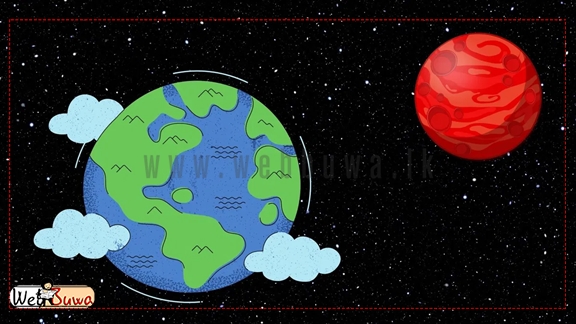
Mars’ gravitational pull on Earth may be influencing the climate on our planet, new research hints.
Geological evidence spanning over 65 million years and collected from numerous sites worldwide indicates fluctuations in deep-sea currents, alternating between periods of heightened and diminished strength. These cycles, known as “astronomical grand cycles,” occur approximately every 2.4 million years.
The stronger currents, known as “giant whirlpools” or eddies, may reach the seafloor at the deepest parts of the ocean, known as the abyss. These powerful currents then erode away at the large pieces of sediment that accumulate during calmer periods in the cycle, according to research published Tuesday (March 12) in the journal Nature Communications.
The study discovered that these cycles align with the timing of recognized gravitational interactions between Earth and Mars during their orbits around the sun.
“The gravity fields of the planets in the solar system interfere with each other and this interaction, called a resonance, changes planetary eccentricity, a measure of how close to circular their orbits are,” study co-author Dietmar Müller, a professor of geophysics at the University of Sydney, said in a statement.
Due to this resonance, the Earth is pulled slightly closer to the sun by Mars’ gravitational pull, meaning our planet is exposed to more solar radiation and hence has a warmer climate, before drifting backward again — all over a period of 2.4 million years.
The authors of the new study used satellite data to map the accumulation of sediment on the ocean floor over tens of millions of years. They found that there were gaps in the geological records where sediment stopped building up within these astronomical cycles. They believe that this could be linked to stronger ocean currents as a result of warmer weather caused by Mars’ gravitational influence on Earth.
These findings support the idea that the Red Planet influences the climate on Earth, just as passing stars and other astronomical objects have been theorized to. However, the observed warming effect is not linked to global warming that is being driven by human greenhouse gas emissions, the authors emphasized in the statement.
Nevertheless, although speculative at this stage, the findings suggest that this cycle may help periodically maintain some of the ocean’s deep currents in the event that global warming decreases them, the authors say.
“We know there are at least two separate mechanisms that contribute to the vigor of deep-water mixing in the oceans,” Müller said. One of these mechanisms is known as the Atlantic Meridional Overturning Circulation (AMOC), Müller said. This acts as an ocean “conveyor belt,” bringing warm water from the tropics to the Northern Hemisphere, pulling heat deep into the ocean in the process.