





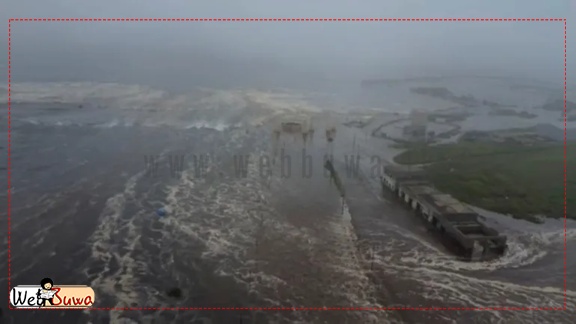
Vast stretches of Japan’s Pacific coastline were struck by tsunami waves reaching up to 60 centimeters on Wednesday following a powerful magnitude 8.8 earthquake off Russia’s Kamchatka Peninsula earlier in the morning. The Japan Meteorological Agency (JMA) maintained its tsunami evacuation warning, urging residents in at-risk areas to stay alert.
The warning spanned a broad region from northern Hokkaido to western Wakayama Prefecture, causing major disruptions to rail, road, and air travel along the coast. In response, the Fukushima Daiichi nuclear plant operator suspended the release of treated radioactive water into the Pacific Ocean as a precaution.
Although the JMA warned that tsunami waves as high as 3 meters were possible, the largest waves recorded so far were 60 cm, observed in Hamanaka (Hokkaido) and Kuji Port (Iwate Prefecture) shortly after 1 p.m. Smaller waves, including a 20 cm surge, were observed in Tokyo’s Harumi district, and others were detected in central, southwestern, and southern regions, including Aichi, Kagoshima, Miyazaki, and Okinawa.
Authorities emphasized that tsunami activity could persist for the rest of the day. “We expect elevated wave levels to continue for at least another day,” a JMA official stated at an afternoon press briefing.
Prime Minister Shigeru Ishiba vowed to ensure public safety, directing government ministries and agencies to take all necessary steps to minimize tsunami-related damage. Chief Cabinet Secretary Yoshimasa Hayashi also urged residents in affected areas to evacuate to higher ground during an emergency morning press conference.
The earthquake, recorded at 8:24 a.m. Japan time, occurred about 120 kilometers east-southeast of Petropavlovsk-Kamchatsky at a depth of approximately 20 km, according to the U.S. Geological Survey. Russia’s TASS news agency reported tsunami waves of 3 to 4 meters in some Kamchatka districts.
Initially issued as an advisory, Japan’s tsunami alert was upgraded to a full warning after the earthquake’s magnitude was revised upward from 8.0 to 8.8. The quake registered a level 2 on Japan’s seismic intensity scale in parts of Hokkaido.
In response, several airports and railway companies—including Sendai Airport and JR East, JR Central, and JR Hokkaido—suspended operations near coastal zones. Trains were stopped, and passengers and crew were evacuated.
At the Fukushima Daiichi facility, which is still undergoing decommissioning after the 2011 disaster, workers were relocated to higher ground, and the release of treated water was halted at 9:05 a.m. No abnormalities were reported at any nuclear sites.
The tsunami warning also disrupted business operations. Nissan Motor Co. suspended production at facilities in Kanagawa and Fukushima, while convenience store operators like Seven-Eleven Japan closed hundreds of outlets along the coast. Beaches in Miyagi Prefecture were also closed to the public.
For historical context, a magnitude 8.2 quake in the Kamchatka region in 1952 caused 3-meter waves in Japan, damaging over 1,200 homes. In contrast, the 2011 M9.0 quake led to waves exceeding 10 meters and triggered a catastrophic nuclear accident at Fukushima Daiichi.