







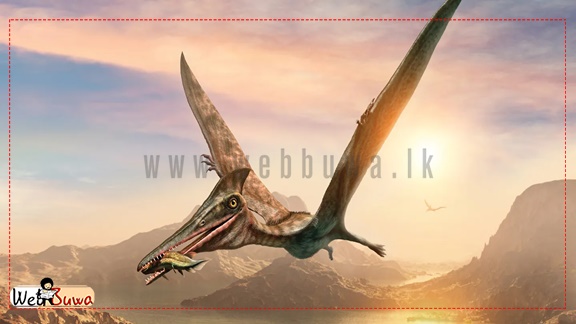
Paleontologists have identified a new species of pterosaur after examining 100-million-year-old fossilized bones found in western Queensland, Australia. These remains belonged to a flying reptile that lived among dinosaurs.
The study, titled “Haliskia peterseni, a new anhanguerian pterosaur from the late Early Cretaceous of Australia,” was published in Scientific Reports. Led by Curtin University, the research is based on fossilized remains discovered in 2021 by Kevin Petersen, curator at the Kronosaurus Korner Museum in Richmond, Australia. The fossils belong to Haliskia peterseni, a newly identified genus and species of anhanguerian pterosaur.
Previous research has shown that pterosaurs were flying reptiles that lived from the Late Triassic to the end of the Cretaceous period. They varied greatly in size, from small bird-like creatures to massive predators with enormous wingspans. Pterosaurs, including Quetzalcoatlus—the largest known flying animal—have been featured in Hollywood films like Jurassic Park.
The research team, led by PhD student Adele Pentland from Curtin’s School of Earth and Planetary Sciences, identified the specimen as an anhanguerian. They analyzed its skull shape, tooth arrangement, and shoulder bone structure.
Anhanguerians were a group of pterosaurs known to have lived globally, including in regions that are now Brazil, England, Morocco, China, Spain, and the United States. “With a wingspan of approximately 4.6 meters, Haliskia would have been a formidable predator about 100 million years ago when much of central western Queensland was submerged under a vast inland sea, positioned where Victoria’s southern coastline is today,” said Pentland.
“Mr. Petersen’s careful preparation has revealed the most complete anhanguerian specimen, and indeed any pterosaur, discovered in Australia to date. Haliskia is 22 percent complete, making it more than twice as complete as the only other partial pterosaur skeleton found in Australia.
“The specimen includes complete lower jaws, the tip of the upper jaw, 43 teeth, vertebrae, ribs, bones from both wings, and part of a leg. Additionally, very thin and delicate throat bones, indicating a muscular tongue useful for feeding on fish and cephalopods, are present,” Pentland added.