







A new telescope, hailed as the world’s highest astronomical site, has officially commenced operations.
Situated atop the Chilean Andes at a staggering altitude of 5,640 meters (18,500 feet) above sea level, the Japanese University of Tokyo Atacama Observatory (TAO) marks a significant milestone in its 26-year journey from conception to realization.
Envisioned to delve into the evolution of galaxies and exoplanets, TAO occupies the summit of Atacama’s Cerro Chajnantor mountain, a name derived from the now-extinct Kunza language, meaning “place of departure” in homage to the indigenous Likan Antai community.
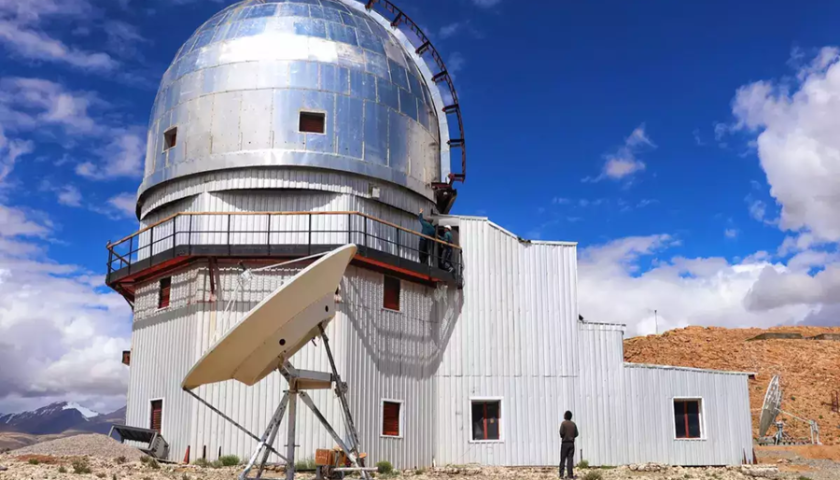
The site’s lofty elevation, along with its sparse atmosphere and persistently arid climate, renders it inhospitable to human habitation. However, these very conditions make it an ideal locale for infrared telescopes like TAO, as they depend on minimal moisture levels to ensure the transparency of Earth’s atmosphere in infrared wavelengths.
For Yuzuru Yoshii, a professor at the University of Tokyo and the driving force behind TAO since 1998, the journey to construct the telescope was not just a technical feat but also a political endeavor. Liaising with indigenous peoples to honor their rights and perspectives, securing permissions from the Chilean government, collaborating with local universities for technical expertise, and ensuring safety protocols with the Chilean Health Ministry were among the multifaceted challenges overcome.
Expressing gratitude for the collective effort, Yoshii emphasizes the realization of research dreams. TAO’s 6.5-meter telescope hosts two advanced instruments tailored for infrared observations of the universe. SWIMS, one of the instruments, aims to capture images of galaxies from the universe’s infancy, shedding light on the enigmatic processes of their formation from pristine dust and gas. Complementing this endeavor, MIMIZUKU focuses on scrutinizing primordial dust disks, the cradles of star and galaxy birth.
Reflecting on the significance of astronomical observations, Riko Senoo, a graduate student at the University of Tokyo and a TAO researcher, underscores the vital role they play in enhancing our understanding of the cosmos. Looking to the future, Masahiro Konishi, a research associate at the University of Tokyo, hopes that TAO, along with other ground-based and space telescopes, will inspire the next generation of astronomers to unravel mysteries yet unseen and challenge existing paradigms.
Before TAO’s inauguration, Yoshii and his team established and operated a 1-meter telescope, named miniTAO, in 2009. This miniature marvel garnered acclaim, earning the Guinness World Record for the highest astronomical observatory on Earth two years later.

While discussions surrounding the observatory spanned over two decades, on-site groundwork commenced in 2006 with the construction of the first access road to Mt. Chajnantor’s summit, followed by the installation of a weather monitoring system. Preceding the telescope’s construction, a solemn ceremony was conducted by astronomers and local community members to purify the site and invoke divine blessings for the project’s success, as recounted in a previous news release by the project team.