

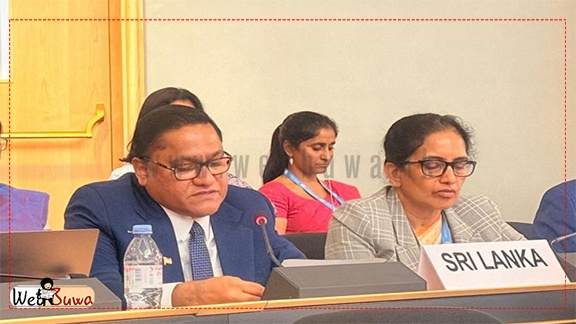
Minister of Foreign Affairs, Foreign Employment and Tourism, Vijitha Herath, reaffirmed the new government’s commitment to transformation in Sri Lanka and its determination to build a new political culture that promotes the rights and well-being of all citizens.
Addressing the 60th Session of the United Nations Human Rights Council (UNHRC) in Geneva on September 8, during the Interactive Dialogue on Sri Lanka, the Minister emphasized the progress achieved in a short span through domestic initiatives aimed at fostering national unity and reconciliation. He called on the Council to grant Sri Lanka the time and space necessary to advance these efforts.
A total of 43 countries participated in the Interactive Dialogue, including Kuwait on behalf of the Gulf Cooperation Council (Bahrain, Kuwait, Oman, Qatar, Saudi Arabia, and the UAE), along with Ethiopia, Côte d’Ivoire, the Philippines, Japan, Lao PDR, Thailand, Vanuatu, DPR Korea, Eritrea, Iran, Nepal, India, Zimbabwe, Viet Nam, China, Azerbaijan, Indonesia, Türkiye, Belarus, Egypt, Venezuela, the Maldives, Cuba, South Sudan, Sudan, the Russian Federation, and Burundi.
Expressing solidarity with Sri Lanka, these countries:
- Welcomed the country’s continued engagement with the UNHRC and the High Commissioner’s recent visit as a positive sign of cooperation;
- Recognized significant progress and legislative reforms underway, while encouraging support for Sri Lanka’s nationally driven processes;
- Raised concerns over resources allocated to external mechanisms on Sri Lanka amid broader Council funding constraints;
- Warned that parallel, externally imposed processes could deepen polarization;
- Stressed that country-specific mechanisms undermine the Council’s founding principles of universality, impartiality, objectivity, and non-selectivity;
- Voiced concern over double standards, politicization, and the instrumental use of human rights to interfere in internal affairs;
- Underscored the need for constructive dialogue and cooperation within the Council to achieve meaningful outcomes.
Meanwhile, UN High Commissioner for Human Rights Volker Türk welcomed his June visit to Sri Lanka, noting the value of engaging in open dialogue with political leaders, religious representatives, and local communities, the Ministry of Foreign Affairs said in a statement.
Sri Lanka’s delegation to the 60th UNHRC was led by Minister Vijitha Herath and included Ambassador Himalee Arunatilaka, Permanent Representative of Sri Lanka to the UN in Geneva; Dayani Mendis, Director General for United Nations and Human Rights at the Ministry of Foreign Affairs; and diplomatic officers of Sri Lanka’s Permanent Mission in Geneva.